Larson 2025
With Youtube, Marshall McLuhan’s prediction of non-linear learning is evident—many people now learn guitar by jumping straight to their favorite songs rather than progressing from simple to difficult pieces.
The result is a lot of guitar players who can play songs from rote memory, but don’t really understand the process of memorizing and performing songs.
I started trying to find an analogy that explains this to help students, and while it’s abstract, I think it’s similar to doing carpentry and not knowing the names of the tools. You call the Hammer a “poundy thing,” and a screwdriver “twisty thing,” you don’t really know what a chisel is because you haven’t used it, and it resembles the “Twisty Thing.”
While my story is funny, I started thinking about this when I’m working with students and they are struggling to learn songs, but they can play 30-45 seconds of a hard song, yet struggle with comprehensive song learning. The prevalent non-linear learning style often leads them to bypass foundational skills crucial for musical development.
It’s because their non-linear learning style has resulted in them skipping over a lot of foundational building blocks.
Don’t get me wrong, I’m a fan of Non-Linear Learning, I don’t think you need to go to Automotive Technician school because your car’s alternator has failed, and you can’t afford to have it towed to dealer for repair and need to solve the problem yourself. If you want to make a career as an Auto Technician some foundational classes teaching you about tool usage, nomenclature, and traditional troubleshooting can help you be successful.
I could apply this idea to various topics associated with playing guitar, but understanding intervals is probably the best place to start. Imagine if your friend asked if you wanted to do a workout, Running 100 Meter Intervals. You don’t have any idea how far 100 meters is and ask how many hours that will take. Your friend laughs and says it takes on average 15-30 seconds.
I see this regularly in Guitar Class: It’s common that Guitar Players aren’t aware of the distance of intervals between common notes.
I have noticed over years of teaching that often people with a background in Piano have a very clear understanding of Chord Construction, and interval distances. I believe this is a product of how the Piano is laid out, if you sit at the piano and play any note if you move your hand to the right the second note will always be higher in pitch (sound), and the converse is true if you move your hand to the left the note will always be lower in pitch.
The student’s recognition of these elements helps them to have a better understanding of how the music functions, instead of just purely memorizing.
To help students build a facility with these concepts I have developed a series of worksheets, and exercises to teach the intervals, and practice playing them on guitar. These intervals are truly the tools we use to build music, and knowing the names is important place to start.
Interval naming schemes go back in history to the Greek Era (965 BC). The intervals were originally named by simply counting the number of letters used in said interval. One important element that is often omitted is during the Greek Era the Musicians didn’t use the Sharp (#) and Flat ( b) Notes. This is why it was very easy for them to count the intervals without confusion. If you played the A and then B is a whole step (two frets). That Musical Interval contains Two Letters and would be called a Second. The Interval E to F would also be a second even though its only a half-step (one fret).
We are going to start by learning to play Minor Second Interval a distance of one fret. We will play Note A and then move up one fret to Note Bb. This interval uses two letters, the Letters A & B, but moves only one fret so it involves the notes A & Bb this is the smaller of the two Intervals using notes A & B so it’s called the “Minor Second.”
There is an Interval using two frets with the Letters A & B. This interval will move from A to B, and it is the bigger of the two and it’s called a Major Second.
Step 1. We need to make sure we are comfortable with the A notes most frequently played on the Guitar.
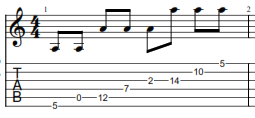
This example shows an A note on every string, except string 5 & String 3, I included two A notes on these strings because I’m trying to avoid using Open Strings for these Examples.
Step 2. Play the Minor Second Interval in a Single String & then on Two Adjacent Strings.
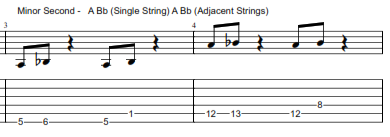
This example shows note A on (String 6 fret 5), and Bb on (String 6 fret 6), then we play the exact same notes across two strings A String 6 Fret 5, Bb String 5 Fret 1. This two-string interval involves a stretch outside of closed position. I will continue with examples of Minor Seconds on the other string groups.

Step 3. Play the Major Second Interval in a Single String & then on Two Adjacent Strings.

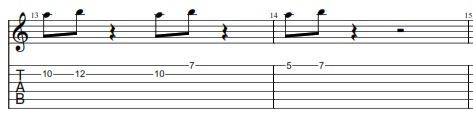
The above Example shows notes A (String 6 Fret 5), and B (String 6 fret 7). Then we play Major Second Interval across two adjacent strings Note A (String 6 Fret 5), and B (String 6 , Fret 7). I will continue with examples of Major Seconds on other string sets.